Svirid
Doctor ZhivagoSvirid, a half-Buriat trapper among the Forest Brotherhood, is a warm-hearted and largely inarticulate witness to the human consequences of partisan rule and civil war. His sympathetic nature gives a humane counterpoint to the camp’s ideological arguments and military orders: he can recognize suffering clearly, but struggles to make his knowledge count when he tries to speak to Liberius.
Identity and Presence
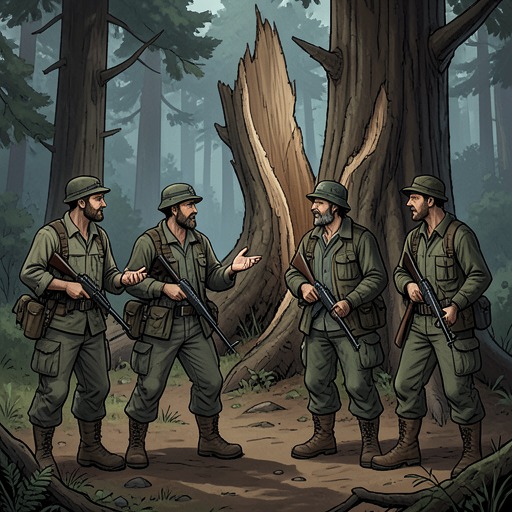
Svirid is introduced beside Vdovichenko, sitting on the floor of the partisan shed. Though he is not a farmer, his earthy presence is conveyed through his open dark shirt and the cross around his neck, which he bunches in his hand and uses to scratch his chest. He is illiterate, with thin braids, a sparse moustache and beard, and Mongol features that make his face seem older. The account emphasizes not severity but a sympathetic smile: his appearance and gestures establish a man at ease with the physical world, rather than with formal political language.
The bond between Svirid and Vdovichenko is described as friendship and shared wandering. When Vdovichenko argues that civic institutions should grow from below like seedlings rooted in soil, Svirid backs him in homely terms. Their analogy turns political debate into an image of irreversible commitment: once the partisans have begun, they have to fight on, as people must eat the soup they have cooked or keep moving after jumping into water. His comparison is practical rather than theoretical, but it expresses the urgency and entrapment of the group’s situation.
Among the Partisans
Svirid’s connection to the Forest Brotherhood is not simply voluntary. After Vdovichenko is shot because his influence rivals Liberius’s and causes dissension, Svirid is deeply shocked. He longs to leave the partisans and return to his former private, independent life, but understands that departure would mean execution as a deserter. His loyalty is therefore constrained by coercion: the independent life he wants remains imaginable, yet is no longer available to him.
At the highway near the edge of the taiga, Svirid tries to speak with Liberius while officers wait for the commander to decide whether to cut the telegraph line. Liberius keeps signaling for them to wait, but his attention is divided, and Svirid has to compete with the immediate business of command. His attempt to report what he has seen is thus staged against a concrete military decision: the road, the officers, and the telegraph line press upon a conversation about people whose suffering does not fit neatly into operational plans.
Witness to the Refugees
Svirid has been sent to meet the women refugees and returns with an account of a confused evacuation, shaped by conflicting orders that cannot be carried out. He reports that some young mothers, walking with sacks, bundles, and babies, have lost their milk and become overwhelmed by the journey. In despair, they abandon children, spill their grain onto the ground, and turn back, judging a quick death preferable to starvation or the dangers of the forest. The report is not an abstract warning about morale: it gives material particulars of hunger, exhaustion, and family separation.
He also distinguishes the women who have succumbed to despair from those who endure. The strongest, he says, show courage and self-control unmatched by men. This contrast prevents the refugee women from becoming a single, undifferentiated mass in his account. Their actions arise under extreme pressure, but Svirid sees different responses within that pressure, and his testimony preserves both the collapse and the courage.
The refugees’ route becomes a physical measure of their effort. After Dvory is burned, leaving only cinders where the mill and village had stood, some of the displaced turn back toward the Whites while others continue toward the partisans. Svirid explains that people sent to guard the women helped them cut a road through the taiga and swamps: twenty miles, including bridges. The achievement is extraordinary, but Liberius immediately sees its military danger. A road that carries refugees through the forest may also give White artillery a way into the taiga. Svirid’s news therefore reveals the double edge of civilian survival: the route made to escape devastation can open a path for further violence.
Speech, Power, and Narrative Role
Svirid knows he has a warning to deliver: he fears a new rebellion, more dangerous than the one already suppressed. Yet Liberius has heard similar warnings repeatedly over the preceding two weeks and hurries him along. Svirid’s difficulty is not lack of perception but lack of fluency and authority. He asks for time, explaining that words stick in his throat, then reduces his plea to a direct practical request: Liberius should go to the refugee camp and stop the women’s dispute before the common campaign against Kolchak becomes a civil war among them. The plainness of the appeal makes its urgency legible even as the commander’s impatience diminishes its force.
His account also conveys how easily the language of collective struggle can obscure a breakdown among those supposedly united by it. Svirid invokes the shared fight against Kolchak, but the refugees’ immediate conflict and misery demand attention on their own terms. Through him, the narrative places the rhetoric of military purpose beside the bodies, children, grain, and damaged road that purpose cannot simply subsume. He remains a constrained intermediary: close enough to witness the refugees’ suffering, and close enough to speak to Liberius, but unable to make the commander stop and hear everything he has come to say.